Parking Meters Help Keep San Francisco Vibrant
By Monica Munowitch
Parking Meters Help Keep San Francisco Vibrant
In a dense, vibrant, expensive city like San Francisco which is bounded by water on three sides, space is at a premium. On city streets, which take up about 20% of San Francisco’s land area, there are many different forms of transportation, all competing for that limited space. As a result, on-street parking for cars is just one of many demands that residents, merchants, visitors and others have for the road network. And of course when it comes to on-street parking, curb space is a very limited resource. As it’s not possible to build more curbs, the city uses regulations to help ensure that spaces are available when and where they’re needed most.
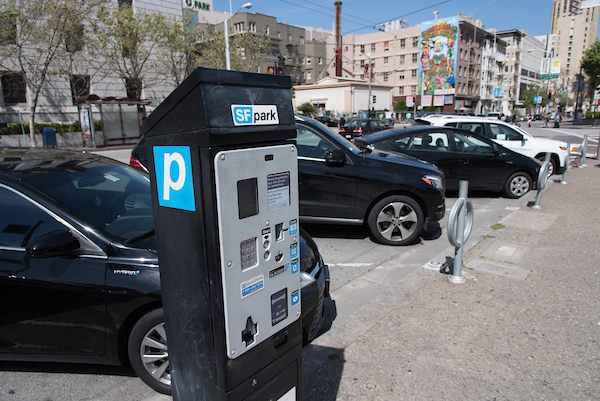
Multi-space Pay Station on McAllister Street
In managing these competing demands, parking meters are the most effective tool we have --particularly in commercial districts and other high-demand areas. They create availability by encouraging people to park only for the length of time they need. This helps to keep spaces available for people whose only option is to drive and park. Without parking meters, the availability of parking in high-demand areas would drop considerably—many spaces could, for example, be taken for days or weeks by people at work, at home or on vacation.
Additionally, when parking is hard to find, people in cars circle the area looking for spaces or double-park while they wait for a space. This leads to congestion for everyone on the street, slows down Muni, creates safety hazards for people walking and biking, and negatively impacts merchants, businesses, and residents. Successful parking management in San Francisco not only increases the availability of parking for people who need to drive, it makes transit more reliable, manages congestion, helps the economy, and creates safer streets.
While parking meters do generate significant revenue for the city, they also have substantial costs. Single-space meters, which make up the majority of meters in San Francisco, cost over $600 apiece; each multi-space paystation (serving 10 or more spaces) costs $6,000. Other costs that the city pays for this valuable tool add up to millions of dollars per year, including labor for installation and maintenance, battery replacement, coin collection, data/communications fees, credit card fees, vendor fees and enforcement staffing.
San Francisco’s City Charter mandates that parking revenues in excess of management costs be directed toward supporting transit —a progressive and forward-looking system that voters approved when they supported the creation of the SFMTA in 1999. So in San Francisco, paid parking and transit are inextricably linked and create a virtuous cycle: paid parking keeps the streets clear of double parkers and cars circling in search of a space and helps transit move faster and more reliably; more reliable transit is more appealing for people and leads to more transit trips, which opens up more parking spaces for the people who need to drive. And when drivers pay for parking, their contributions help fund the transit service that in turn reduces the need for driving. A well-managed parking policy prevents congestion, reduces pollution, makes the streets safer, and provides a transportation lifeline to the hundreds of thousands of San Franciscans who do not have a car. This encourages the type of density and walkability that make San Francisco an appealing place to live, work, and visit.
Published April 08, 2021 at 10:56PM
https://ift.tt/3s6k3xM


Comentarios
Publicar un comentario