miércoles, 27 de octubre de 2021
Show HN: Video Generation from a Text https://ift.tt/2Zs1lZr
Show HN: A Tool to show Stock Market returns If you had Invested in the past https://ift.tt/3nvvFu5
Show HN: Kit55, a Desktop Web Builder GUI – Jekyll, Next, Wordpress Alternative https://ift.tt/2ZrTLOt
Show HN: Coding Font – find your true love of coding fonts https://ift.tt/3pI2czS
martes, 26 de octubre de 2021
Show HN: “HTTP 419 Never Gonna Give You Up” for bots https://ift.tt/3jHJT9X
Show HN: Google search+display revenue alone is more than all of Microsoft's rev https://ift.tt/3nxhHI3
Show HN: Ratskeller Recipes https://ift.tt/3EhBgLc
Show HN: Bubble Cam – Walking simulator from panoramic photography https://ift.tt/3GoAiyD
Animated Map Shows Record Expansion of Transit Lanes
By Michael Rhodes
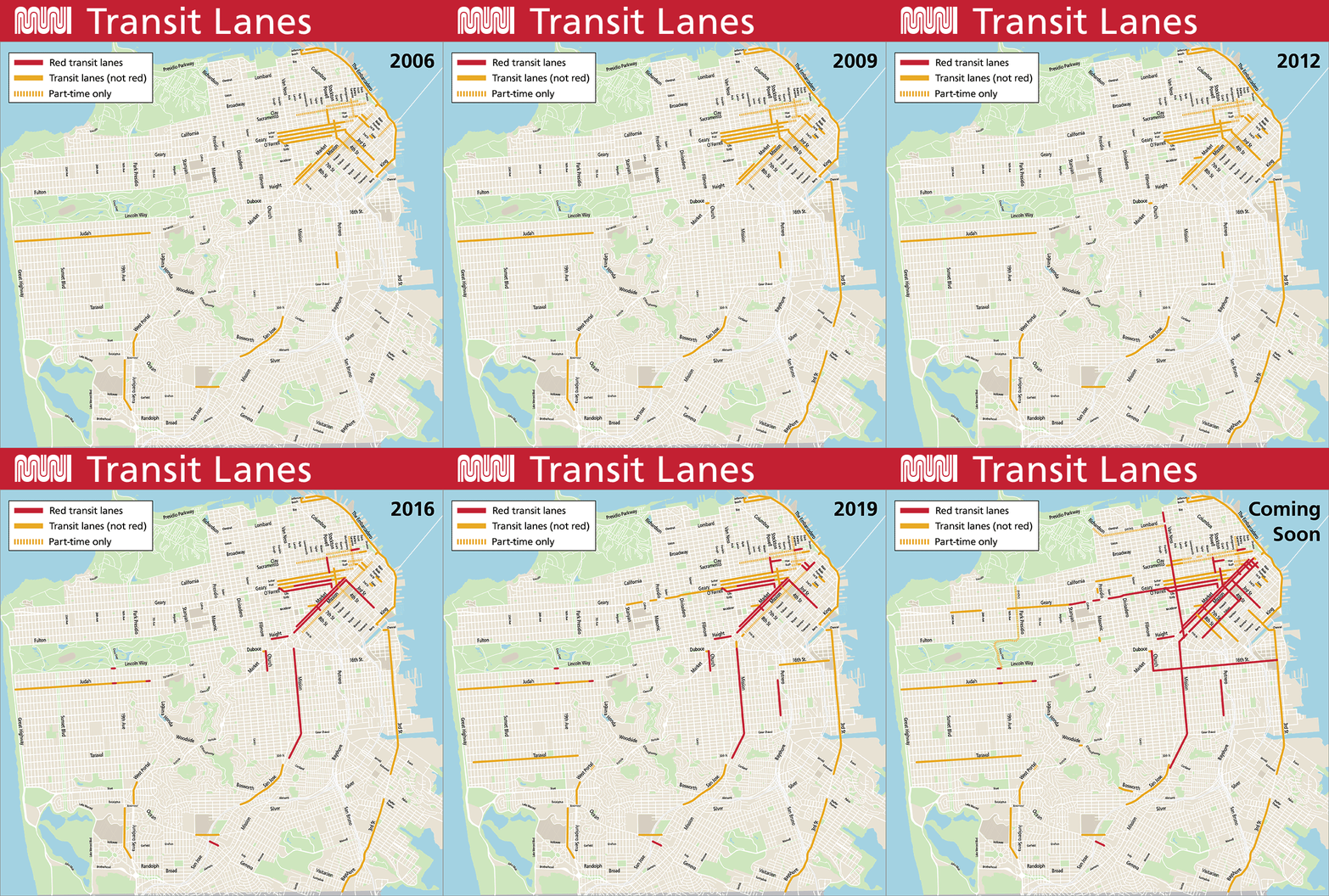
An animated map showing the expansion of transit lanes in San Francisco. View as a PDF.
It’s been a record year for transit lanes in San Francisco: we’ve installed nearly 14 miles of new or upgraded lanes since summer 2020. That’s the fastest expansion of transit lanes in the city’s history. These transit lanes benefit Muni routes that serve nearly two-thirds of current customers. It’s all part of our efforts to give transit riders priority on congested streets and improve Muni speed and reliability. Better Muni service means more people will opt to take transit instead of driving, that reduces congestion and supports our environmental goals.
To commemorate this milestone, we’ve put together an animated map showing the evolution of San Francisco’s transit lane network over the last 15 years. We hope you find it as mesmerizing as we do to watch transit lanes expand across the city during this time.
Transit lanes are dedicated to Muni vehicles as well as other buses and taxis in most cases. They help improve Muni’s travel time and reliability and protect transit riders from traffic congestion. Red transit lanes were first introduced in San Francisco in 2013 and have proven to be even more effective than non-red transit lanes, leading to about a 50% reduction in violations.
We’ve been steadily adding to the transit lane network since the 1970s, when the original Transit First Policy was adopted, but the past five years have been especially busy. And as the final map shows, many more transit lanes are fully approved and coming soon, including the much anticipated Van Ness Avenue transit lanes.
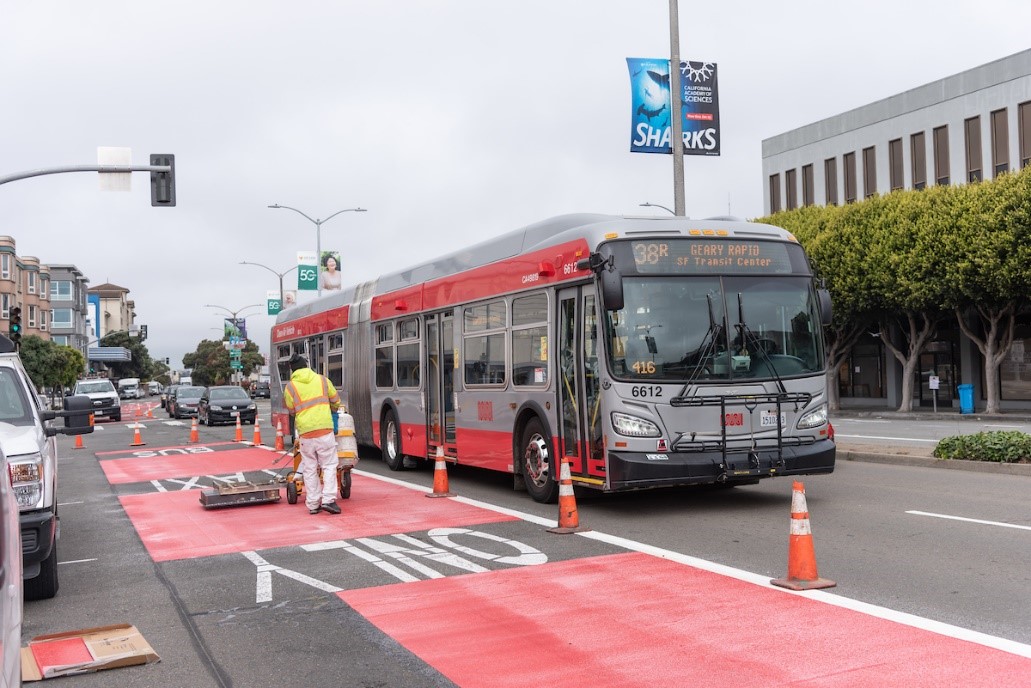
An SFMTA paint shop crew installs new red transit lane on Geary Boulevard
A few highlights to look out for in the map:
- Transit lanes on the T Third, installed as part of the line’s launch in 2007
- The city’s first red transit lanes, installed on Church Street in 2013
- The major expansion of red transit lanes in 2014, including Geary, O’Farrell, Market, Haight and 3rd streets
- The evolution of Market Street in downtown from a short segment of transit lanes in 2006 to full transit lane coverage by 2021
- The extension of transit lanes on Geary Boulevard, our busiest bus corridor, in 2018 and 2020 to cover nearly the entire 38 Geary /38R Geary Rapid lines (with more red paint on its way!)
- The upgrading of existing transit lanes on Mission Street in SoMa from part-time to 24/7 in SoMa in 2021 (soon to be upgraded with red paint)
- A short but important new transit lane on the 4th Street bridge added in 2021, filling a key gap in the T Third’s transit lanes
- The record-setting expansion of transit lanes in 2020 and 2021 as part of our Temporary Emergency Transit Lanes program, which benefits nearly half of all current Muni riders
- The state’s first urban arterial HOV lanes, installed on Lombard Street in September 2021
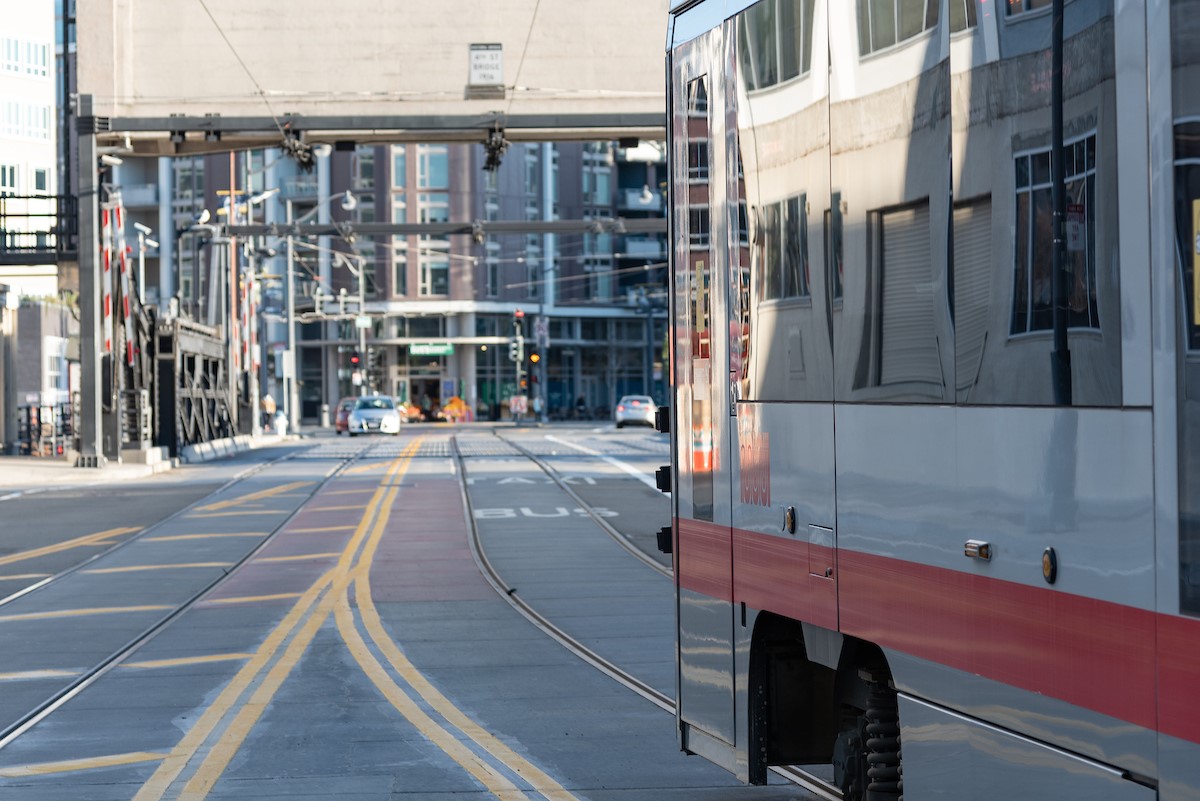 A train crosses a new transit lane on the historic 4th Street Bridge
What’s Next
Transit lanes have proven their worth in getting Muni riders where they’re going faster yet again this year, and more are on the way. In addition to installing transit lanes that are already approved, we’ll be starting outreach on a new round of Muni Forward projects in the coming year to deliver faster, more reliable and less crowded service to Muni customers. These projects will include transit lanes and other transit priority measures that keep Muni moving. Sign up for our Muni Forward mailing list to receive updates about new transit lanes coming your way.
Map Notes
For those who can’t get enough detail about transit lanes, here are a few more notes about how we created the map:
- We didn’t differentiate between one-way and two-way transit lanes on the map, except on Market Street
- We included any dedicated lane within a city street as a transit lane, including rail tracks that can’t be used by buses. Subways, tunnels and rail rights-of-way that are entirely separate from any roadway (such as the J Church right-of-way through Dolores Park) were not included.
- We included HOV lanes on Lombard that serve the 28 19th Avenue bus line, but didn’t include a short stretch of HOV lane on Bryant Street because it’s not used by transit
- In a few cases, transit lanes go away temporarily during roadway construction, such as on 4th Street for the Central Subway. In rare cases, transit lanes are removed because transit is rerouted to a new street, such as the transit lane on Harrison Street that served the old 12 Folsom route before it was eventually rerouted a block north to Folsom Street.
- Not all approved Temporary Emergency Transit Lanes on the 43 and 44 lines are shown as we’re monitoring transit performance to help us determine when to move forward with these lanes. Learn more on the 43/44 TETL project webpage.
Published October 26, 2021 at 08:02PM
https://ift.tt/2ZuiUYw
Show HN: my book, The Minimalist Entrepreneur https://ift.tt/3jzExO7
Show HN: QuickServ • Dangerously user-friendly web server https://ift.tt/3bf75rs
Show HN: Stockstack 0.5.0 – Financial data aggregation made easy https://ift.tt/3vUbA4s
Show HN: Scribe generates step-by-step guides for GUI workflows (Free and Paid) https://ift.tt/3nunrCv
Show HN: TopNotch.app – Hide the notch on your new MacBook https://ift.tt/3mfJfCf
Show HN: Demeter, the Hacker's Feed Reader https://ift.tt/3bc08r9
Show HN: CookLang – Recipe Markup Language https://ift.tt/2XQmGec
lunes, 25 de octubre de 2021
Show HN: Jeval allows to run Java scripts as ordinary executable files https://ift.tt/3BgbmW4
Show HN: SQL Basics https://ift.tt/3mcXgRe
Show HN: FullHunt– A new platform to discover all your Internet-connected assets https://ift.tt/3nwdpRh
Show HN: Forth – Rethinking (and improving) News https://ift.tt/3Cd07PC
70 Years at Elkton Shops: Part 1
By Jeremy Menzies
In this two-part blog series, we will look back at the history of one of our city’s hardest working transportation properties. For almost 115 years, the Elkton lot, located on San Jose Avenue between Ocean and Niagara Avenues, has been the epicenter of SF streetcar operations. In this post, we will explore the first 70 years at the property when it was known as “Elkton Shops”.
Built between 1905 and 1907 by the United Railroads of San Francisco (URR) on a several acre field in the outskirts of the city, Elkton Shops was the most comprehensive transit facility in the city. The new shops, mainly surrounded by farmland, were named after a Southern Pacific Railroad stop just steps away on Ocean Avenue.
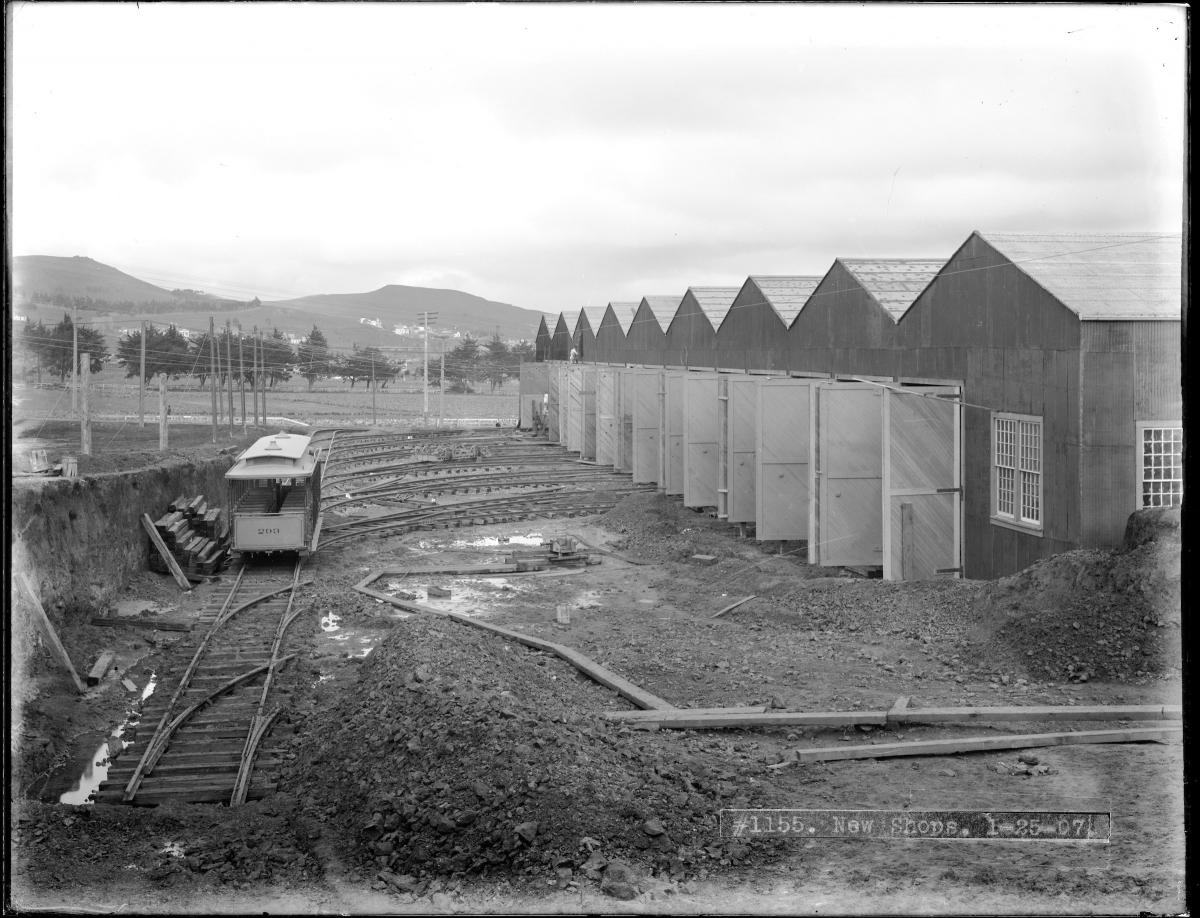 A lone cable car sits on a muddy ladder track outside the newly built Elkton Shops in this January 1907 shot.
In 1921, Elkton changed hands, going to the Market Street Railway Company after URR suffered years of financial troubles. During its heyday in the 1920s, Elkton Shops was a powerhouse of repair and production. A staff of over 350 people were responsible for building and overhauling hundreds of streetcars and cable cars to keep the railway’s sprawling system running.
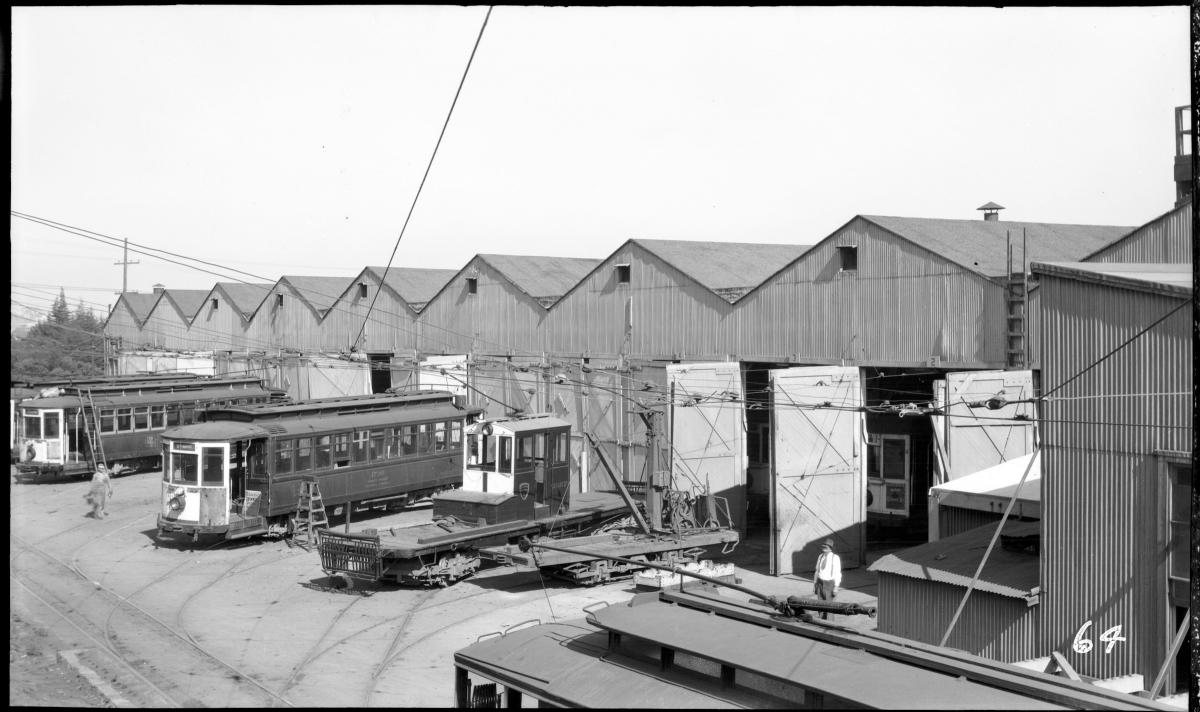 This 1928 photo was taken at the peak of production at Elkton Shops when staff was turning out 26 brand new cars a year on top of 316 complete overhauls and myriad other work.
Every type of job from replacing broken windows and upholstering seats to machining wheels, overhauling electric motors, and painting cars was performed in the shops. According to a 1928 article in the company’s newsletter, the average time it took to completely overhaul a streetcar at Elkton was 19 days. On average, 22 cars would be in the shops undergoing the process at any one time.
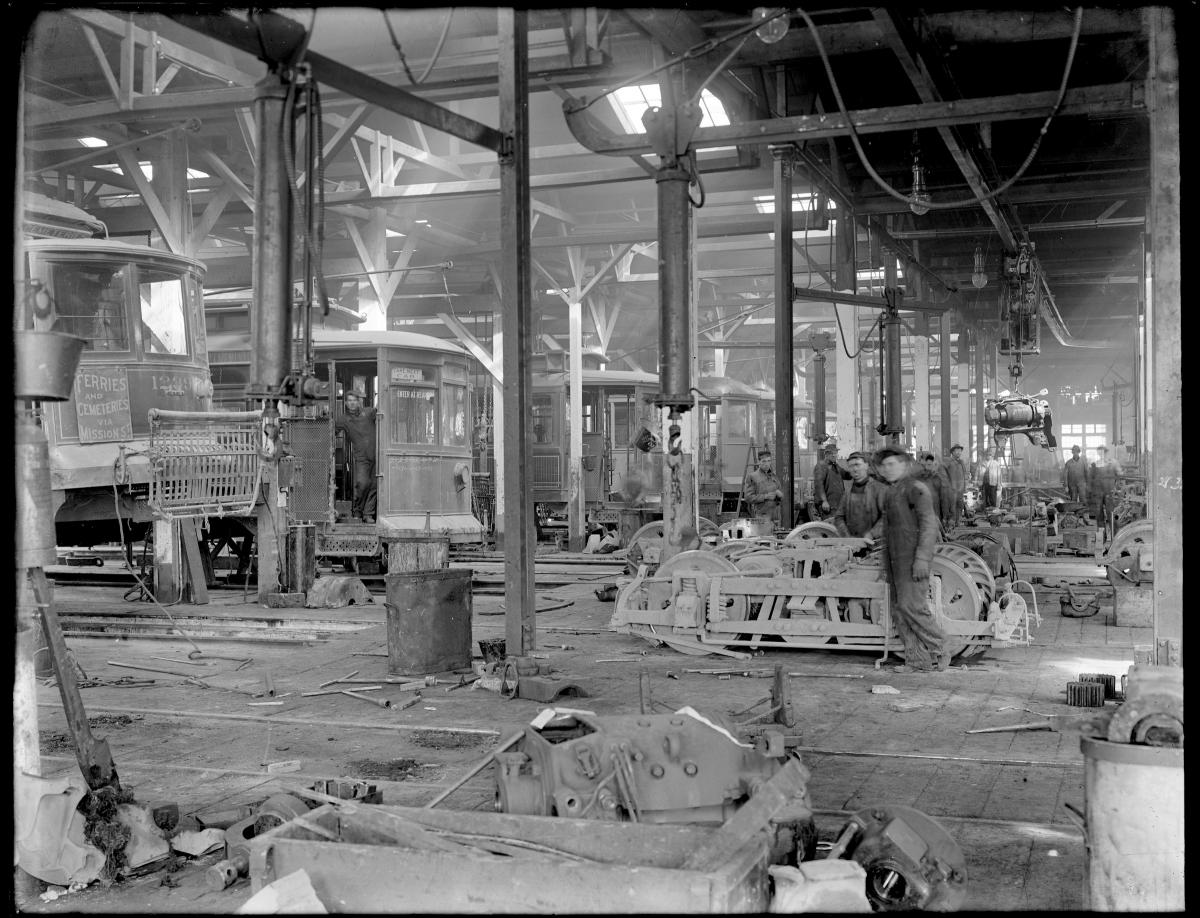 A view inside the overhaul shop in 1912 showing a row of streetcars at left and staff tearing down trucks and motors at right.
In 1944, the Market Street Railway Co. was purchased by the city and Elkton became a part of the now greatly expanded San Francisco Municipal Railway. The heyday of streetcars would soon be coming to an end but the ramshackle old shops continued to hold a valuable place in the future of Muni.
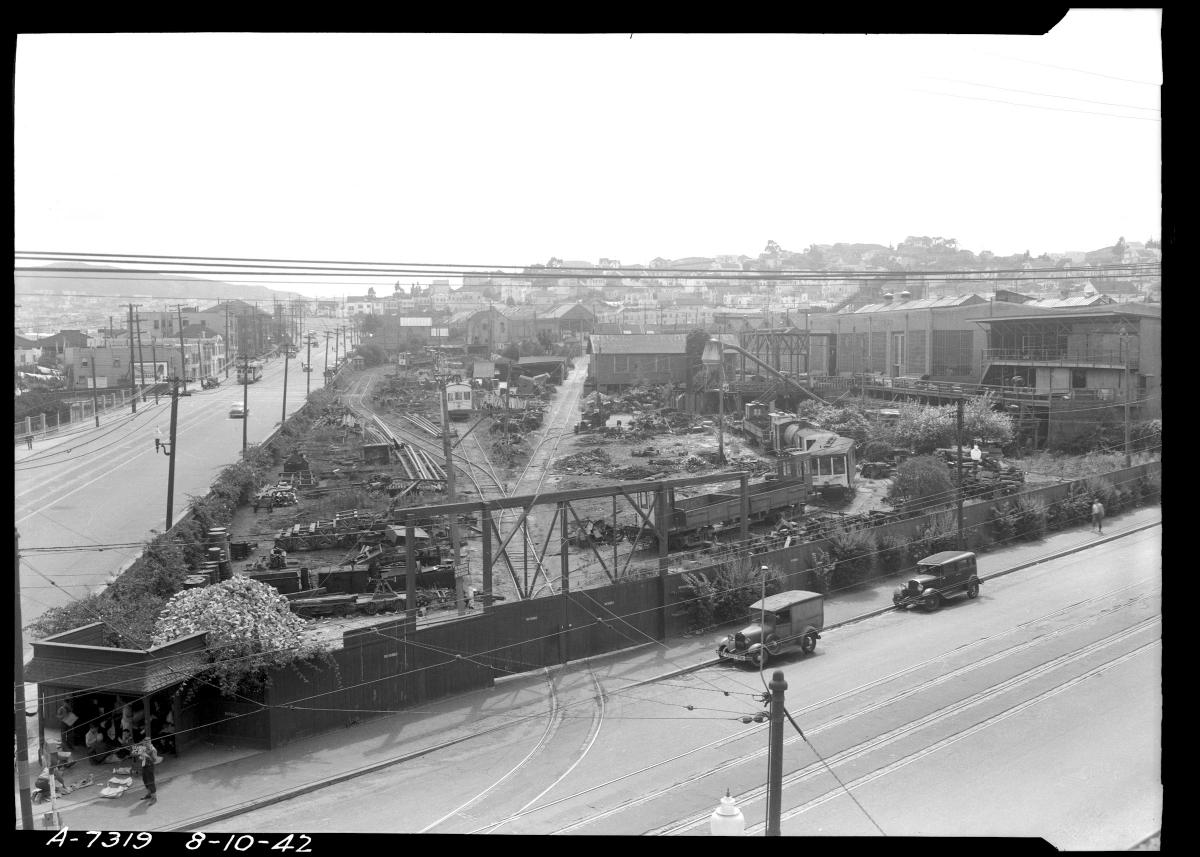 This 1942 shot shows Elkton’s rear yard crowded with everything from cobblestones to streetcar wheels.
Following World War II, Muni began quickly expanding its bus fleet and in 1948, Elkton’s rear yard was cleared and excavated to build the Ocean Division bus yard. The new yard would provide fueling, maintenance and storage for Muni’s growing fleet, including newly leased Mack buses. Elkton Shops remained in service next to the bus yard for another two decades.
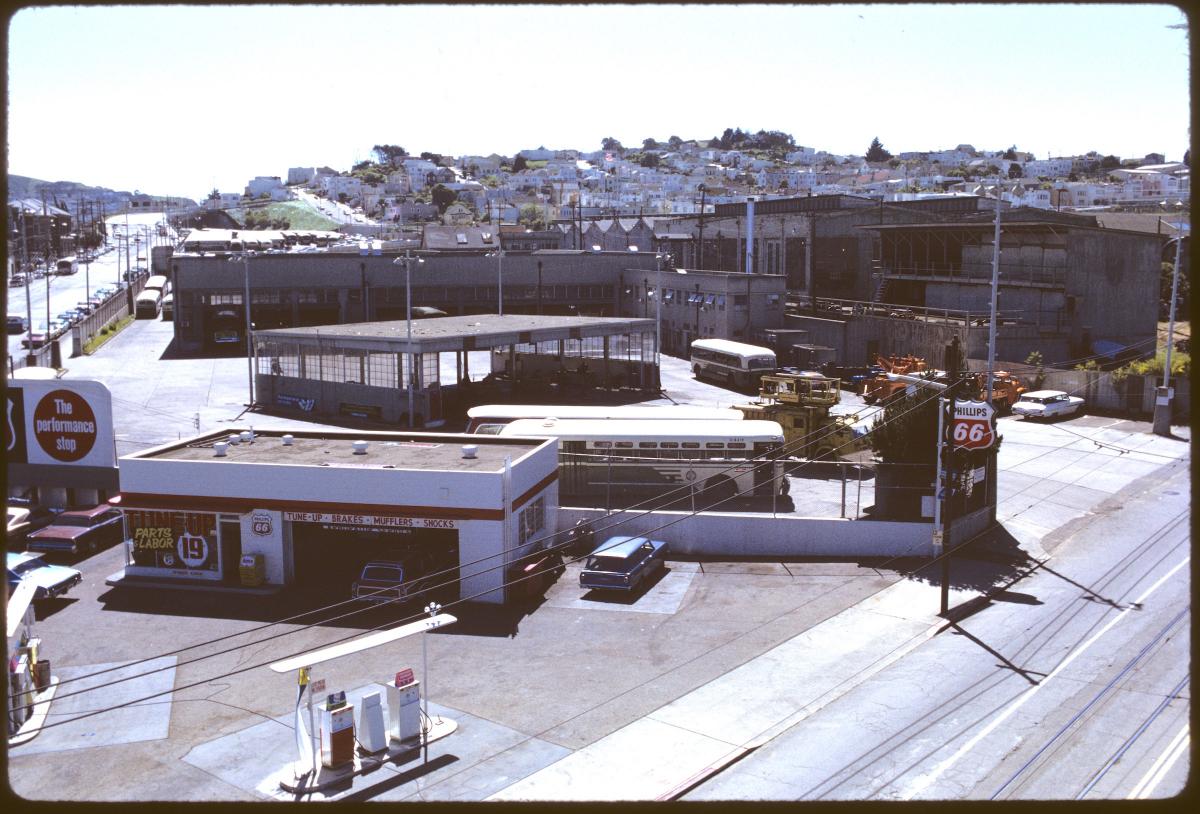 Looking southwest from San Jose and Ocean Avenues, this view shows Muni’s Ocean Division in 1972. At the left is a service station, center the fueling and shop buildings and at right are the Elkton Shops.
The death knell for Elkton occurred in the mid-1970s as the city moved to bring Muni Metro to life with “light rail vehicles.” As these new trains travelled through a subway underneath Market Street, Muni needed a new facility to house and maintain this brand-new fleet. In 1975, Ocean Division was demolished and construction began on what would become the city’s first modern rail repair shop. Just two years later on May 27, 1977, workers at Elkton Shops punched their last timecards in the run-down old building. Four days later, the huge turn of the century shop buildings met their fate with the wrecking ball.
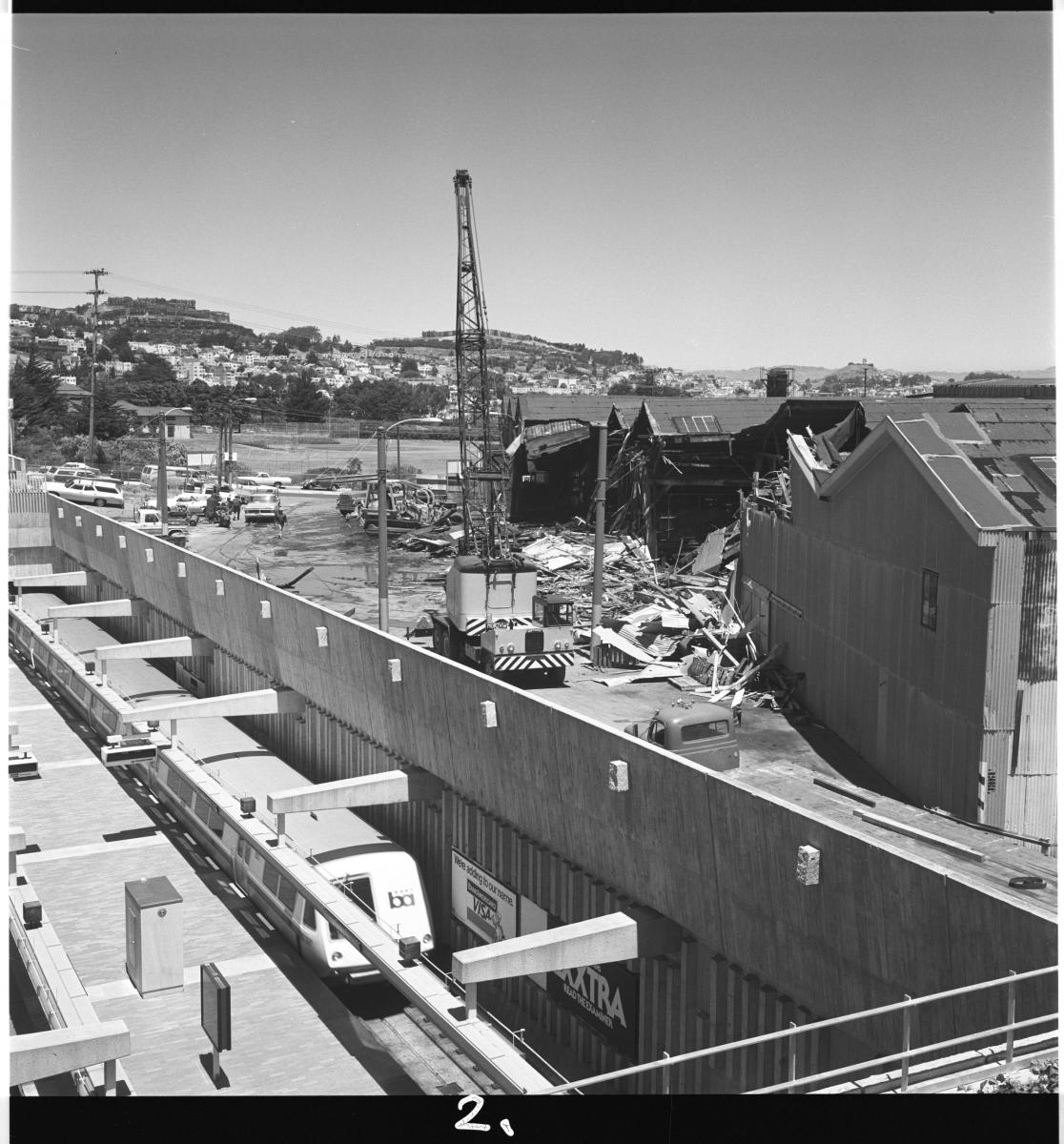 The end of an era came on May 31, 1977 when Elkton Shops was torn down after 70 years of service. In less than 3 years, a rail yard filled with brand new light rail vehicles would stand in place of the old shop buildings.
Tune in next month for part two of this series and learn about the next phase of life at this storied property.
Published October 25, 2021 at 08:09PM
https://ift.tt/2ZsJG3E
Show HN: Made a e-4917 emulator with a short tutorial https://ift.tt/3vHJOYJ
Show HN: Loopple – Drag and Drop Dashboard Builder https://ift.tt/2ZkEZZN
Show HN: Flatmap – a new tool to make vector tiles from OpenStreetMap data fast https://ift.tt/3pBh82G
Show HN: I built a fake VS Code to browse live cricket score in office https://ift.tt/3pA2Dfu
Optimización de SEO para tiendas en línea: Guía completa
Optimización de SEO para tiendas en línea: Guía completa El SEO no es solo importante para las páginas web tradicionales; también es crucial...

-
Watch video on YouTube here: https://youtu.be/PzDZWY6mgGg
-
Watch video on YouTube here: https://youtu.be/3tGZ-bSpFWE
-
Watch video on YouTube here: https://youtu.be/ntljnJmlIv0


