lunes, 25 de octubre de 2021
Show HN: I built a fake VS Code to browse live cricket score in office https://ift.tt/3pA2Dfu
domingo, 24 de octubre de 2021
Show HN: Cybermix – Turn Your 'New Tab' Screen in Chrome into an NFT Gallery https://ift.tt/3vKe3ym
Show HN: Planet TypeScript https://ift.tt/3nt52pB
Show HN: Online editor to create animated SVG https://ift.tt/3GiJsN6
Show HN: Some Thoughts on Interfaces https://ift.tt/3psUWYq
Show HN: Open-source eMarket Online Store v1.0 beta 3 https://ift.tt/3jzgQW1
Show HN: Pimp My Readme https://ift.tt/3ChRBiA
Show HN: Made a web app to read a book carefully, paragraph by paragraph https://ift.tt/3vDhS8c
Show HN: Decoding NOAA weather satellite images using Python https://ift.tt/3E8OI3Z
sábado, 23 de octubre de 2021
Show HN: Free FT https://ift.tt/3jx3bPd
Show HN: LED Website Indicator – an LED lights up when someone visits your site https://ift.tt/3GjxWBg
Show HN: Super low-latency jamming over the internet https://ift.tt/3C8gZXH
Show HN: Create-rust-app, create a modern rust+react webapp with one command https://ift.tt/3E5W0pa
viernes, 22 de octubre de 2021
Show HN: Free FT https://ift.tt/3b4preU
Show HN: Bedull.club a place to share your fun projects https://ift.tt/3vDBnxm
Plans for 2022 Muni Service Take the Next Step
By Mariana Maguire
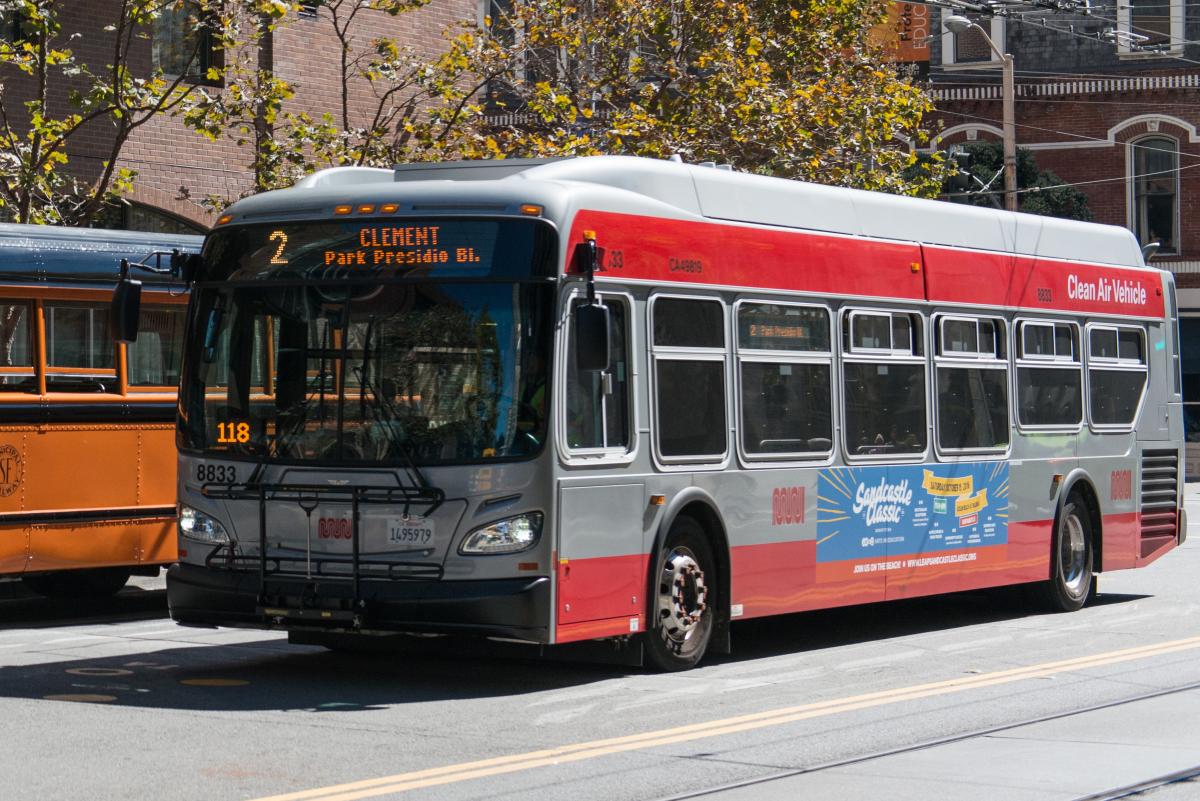
A 2 Clement Muni bus serving its route to Park Presidio Boulevard. The 2 Clement is proposed to return to service in early 2022.
When we asked about what SFMTA should do with resources to expand a bit of service, the SFMTA received more than 4,500 responses to our survey asking San Franciscans what they want to see when we’re able to add more service in February 2022.
We also received detailed feedback about Muni service at meetings, pop-ups and via email and our hotline. In response to that feedback, in early 2022 we are restoring connections, particularly for people with disabilities and seniors. Taking the time to evaluate our service and working with the public, we have also developed ideas for new connections, allowing Muni to take more people more places.
These changes will restore key pre-pandemic connections, preserve or restore Muni access in hilly areas and focus on access for people with disabilities and seniors. At the same time, they will provide new direct connections from the Western Addition, Tenderloin and Richmond District to Caltrain, Oracle Park (Giants’ Stadium) and SoMa, and will provide new through-service between North Beach, Fisherman’s Wharf, Russian Hill and the Marina through all the western neighborhoods.
In the survey responses, we also heard a desire for increased frequency to reduce crowding and wait times on high ridership Muni routes, so we are looking for opportunities where resources allow us to do that as well. Once we know the extent of the impact of the city's vaccination mandate, we will restore as much service as we can, and then increase frequency on high ridership routes to reduce crowding and wait times as resources allow.
Proposed 2022 Muni Service Route Restorations and Improvements
We are proposing to restore five of the seven pre-pandemic routes that are currently still suspended, although some of those routes would be restored with some changes to balance resources.
-
The 2 Clement would be restored to Presidio Avenue and California Street and operate every 15 minutes all day on weekdays
-
The 6 Haight/Parnassus would return every 20 minutes, and the 52 Excelsior and 66 Quintara would return to their past routes
-
The 10 Townsend would be restored to Sansome and Montgomery streets and run along 16th Street in Potrero Hill
-
The 21 Hayes would be restored every 15 minutes to Grove and Hayes streets
-
The 31 Balboa would be rerouted to 5th Street, Townsend Street, 3rd Street and Harrison Street, with a terminal at the 4th and King Caltrain Station
These routes are especially important to access hospitals such as St. Mary’s and UCSF, senior centers, low-cost food options and other key connections among neighborhoods. We also heard the need for more connections to Caltrain, between Potrero Hill and the Financial District.
The 28R 19th Avenue Rapid would also be restored in full for stronger North/South connections and the 43 Masonic would be extended to its pre-pandemic route north of Presidio and California to the Presidio, the Marina and Fort Mason. This responds to the need we heard for connections to Fort Mason and nearby grocery stores.
While we don’t propose to restore the 3 Jackson and 47 Van Ness in early 2022, we are proposing some changes to the 5 Fulton, 12 Folsom/Pacific, 28 19th Avenue, 30 Stockton, 38R Geary Rapid and 49 Van Ness/Mission to help bridge service gaps, including more frequent service to reduce crowding and wait times and route extensions to make connections to grocery stores, hospitals, schools and diverse workplaces.
Changes could also be made to some routes that were temporarily changed during the pandemic, such as the 23 Monterey, 48 Quintara/24th Street, 57 Parkmerced and 58 Lake Merced that could potentially address demand for service along Brotherhood Way, Sloat Boulevard, better access to businesses in Noe Valley, and safety concerns along Clipper Street.
The proposal also includes options for the J Church: When rail service was restored to the J Church line in December 2020, we did not reintroduce the J Church into the subway, ending the line at Church and Duboce. This change allows us to limit the number of trains in the subway, reduce congestion and improve reliability for the entire Muni Metro system. In early 2022, the J Church could remain as it currently is, an all-surface route terminating at Church Street and Duboce Avenue, to maintain the improvement in reliability on the J Church and the 75% reduction in delays we are seeing in the subway. But, it could also be returned to the Market Street Subway evenings only, when there is less congestion in the tunnel, or even full-time.
Next Steps
We will be seeking approval of the service plan by the SFMTA Board on December 7, 2021, and expect to implement the additional service in February 2022. This time frame may be pushed back depending on transit operator availability related to the vaccine mandate.
We will present this plan for input at several upcoming meetings where the public can provide public comment. See SFMTA.com/2022Network for upcoming meetings. To provide feedback, email TellMuni@SFMTA.com or call 415.646.2005.
We expect to finalize the proposal for these improvements to Muni service in November. We will continue to seek additional funding, which we will need to make any further changes. Looking forward to the next 6 months, it is our goal to restore more if we can tackle the long-term funding. We will also continue community dialogue and planning to develop an expansion of our Rapid network and other frequency improvements to address crowding and reduce wait times as the system continues to recover. There are many competing needs for our Muni system. We are doing our best to balance as many of them as possible with the resources that we have.
Published October 23, 2021 at 12:32AM
https://ift.tt/3nkh2tn
Celebrating Quicker Muni Trips on a Safer Geary
By Amy Fowler
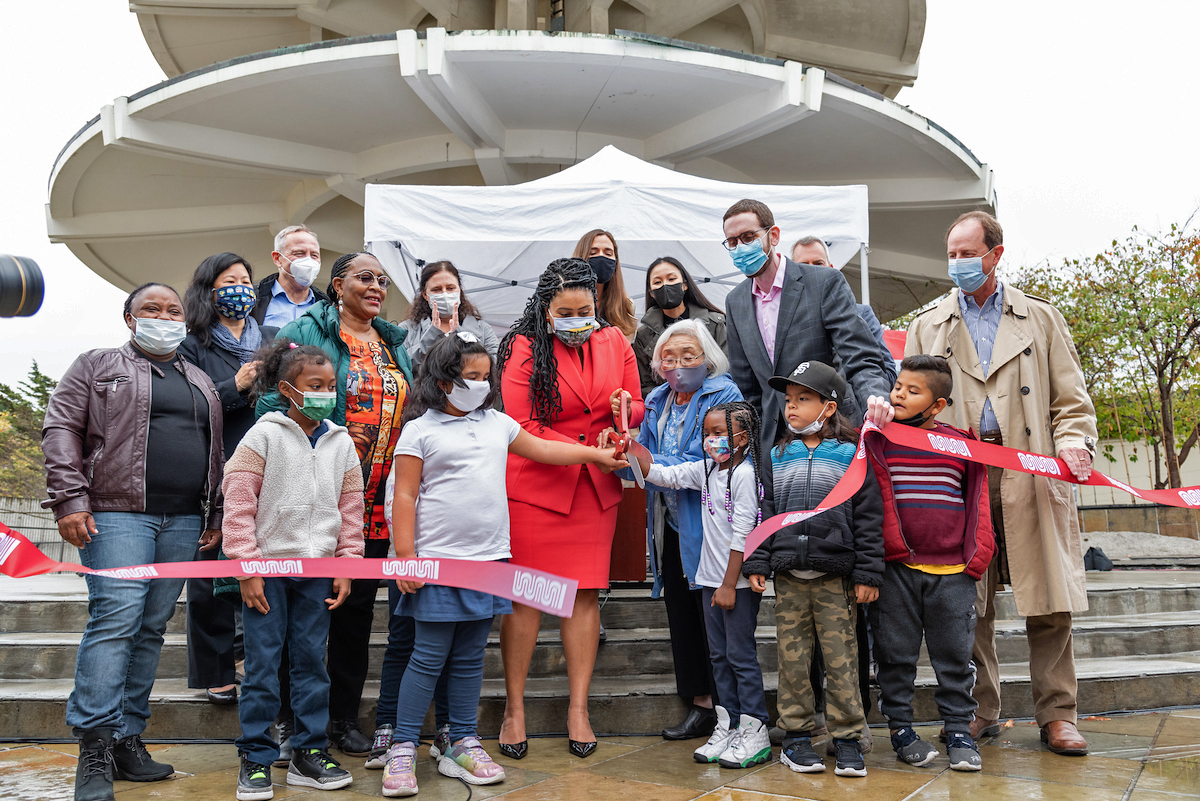
The sky was gloomy but the mood was celebratory at the Japantown Peace Plaza on Wednesday. Fortunately, the rain stopped just long enough for the SFMTA, along with Mayor London Breed and other city departments and community members, to celebrate the completion of the Geary Rapid Project. This major civic improvement project has helped to revitalize one of San Francisco’s busiest corridors between Market and Stanyan streets with more reliable bus service, safer streets, upgraded utilities and new trees.
One safety improvement in particular was a much-anticipated addition for residents of the Fillmore, Japantown and St. Francis Square communities: a new signalized crosswalk at Geary and Buchanan. That and three other new crosswalks in the area are providing safer crossing opportunities for people walking and helping to reconnect neighborhoods that were divided by the Geary Expressway and “urban renewal” in the mid-twentieth century.
Pre-pandemic, the combined Geary routes boasted one of the highest bus riderships in the country, with more than 56,000 daily customers relying on the 38 Geary and 38R Geary Rapid. As riders return, they are experiencing a faster, more reliable ride thanks to transit improvements that were made along the three-mile stretch of Geary.
Dedicated transit lanes, bus stop optimization and signal retiming were implemented at the beginning of the project in late 2018. These quick-build improvements alone resulted in 38R Geary Rapid travel time savings of up to 20%. More recent improvements include coloring the transit lanes red to improve compliance and installing 12 new transit bulb-outs—sidewalk extensions at stops that reduce delays by allowing buses to remain in the travel lane. The Transit Signal Priority system, which helps buses get the green light at intersections more often, has also been upgraded. Now that the full suite of transit improvements has been installed, we’re beginning to assess how well they’re working and will share full evaluation results in 2022.
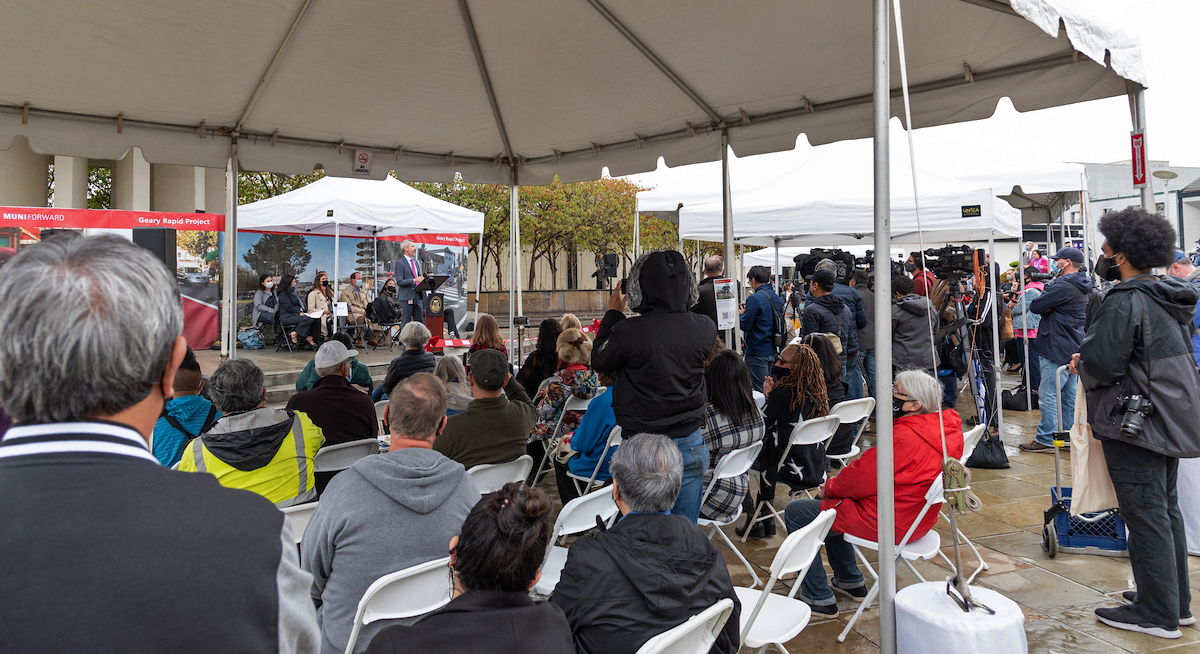
SFMTA Director of Transportation Jeffrey Tumlin makes opening remarks at the Geary Rapid ribbon cutting event
Other upgrades include a host of safety improvements to address Geary’s designation as a high-injury corridor. Thirty-four new pedestrian bulbs-outs were built along the corridor to shorten crossing distances for people walking and slow turning vehicles. Other additions include accessible pedestrian signals, curb ramps, countdown signals and longer crosswalk timing to allow people of all abilities to cross Geary safely. The Tenderloin, where there is a disproportionate number of severe and fatal collisions, was a focal point for many of these improvements.
The Western Addition has also been spruced up with the addition of 31 new trees. The trees, plus visual narrowing of the lanes and reducing the number of travel lanes from eight to six, all work together to give the area more of a neighborhood feel and slow down speeding vehicles who have treated the thoroughfare like a highway.
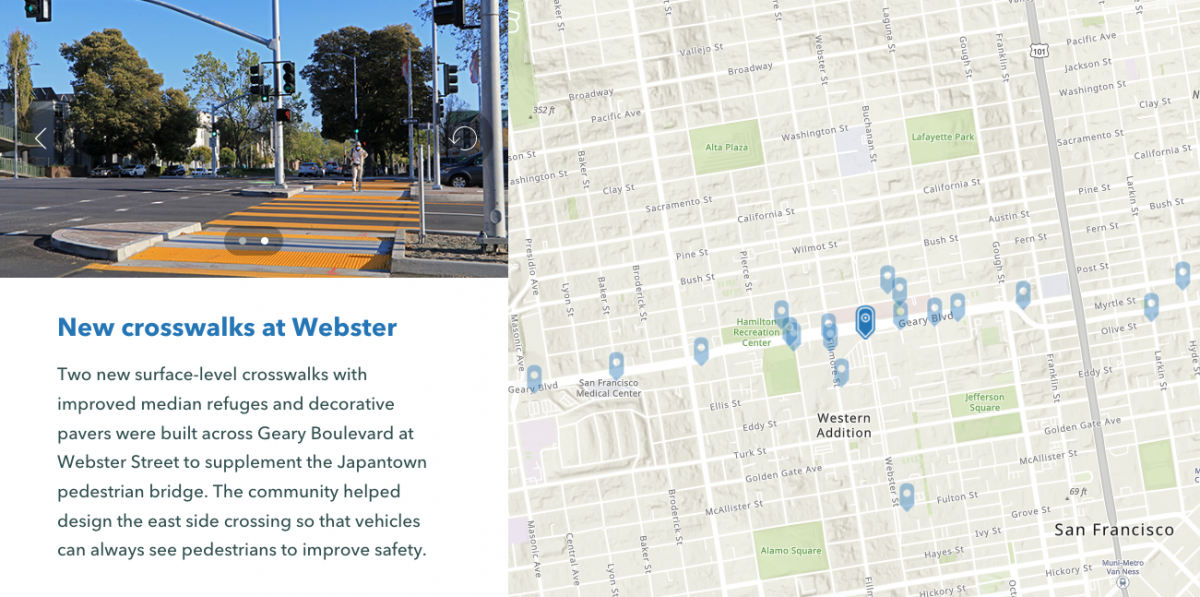
Visit our virtual tour to explore an interactive map of Geary Rapid Project highlights.
This three-year capital project was completed on time and on budget. To minimize the need to dig more than once, construction was coordinated with other City agencies, including 1.5 miles of new sewer mains and almost three miles of upgraded water mains by San Francisco Public Utilities Commission (SFPUC). Public Works has rejuvenated 1.5 miles of deteriorated streets between Masonic and Van Ness avenues with fresh paving.
The Geary Rapid Project is the first of two phases of improvements planned as part of the Geary Corridor Bus Rapid Transit (BRT) project. Outreach and preliminary design is currently underway on the second phase, the Geary Boulevard Improvement Project, which would bring similar transit and safety improvements west of Stanyan Street to 34th Avenue.
Published October 22, 2021 at 11:43PM
https://ift.tt/3E9uUNM
Show HN: Orbital, a video file browser for digital hoarders (like me) https://ift.tt/3m2jNjE
Show HN: Productivity timer where you can postpone breaks and reclaim them later https://ift.tt/30SBmKV
Show HN: I created a tool to schedule HTTP requests https://ift.tt/3C7D9JM
Show HN: Life Perspective Wallpaper https://ift.tt/3jux0QF
Show HN: Semgrep App https://ift.tt/3b1N7jX
Show HN: Search-Engine-Powered Discussion Platform https://ift.tt/3GczXyN
Show HN: Web component – Keyboard shortcuts interface for websites https://ift.tt/30HVejG
Show HN: A library for reading PST emails, written in Go/Golang https://ift.tt/3vAAt4U
Optimización de SEO para tiendas en línea: Guía completa
Optimización de SEO para tiendas en línea: Guía completa El SEO no es solo importante para las páginas web tradicionales; también es crucial...

-
Watch video on YouTube here: https://youtu.be/PzDZWY6mgGg
-
Watch video on YouTube here: https://youtu.be/3tGZ-bSpFWE
-
Watch video on YouTube here: https://youtu.be/ntljnJmlIv0


