

miércoles, 31 de marzo de 2021
Show HN: Signed Work – NFTs, without a blockchain https://ift.tt/3u6uNOb

Show HN: Jamstack deployment providers performance benchmark https://ift.tt/3weJG2C
Show HN: Find people to play tabletop roleplaying games with https://ift.tt/3wpzsNc
Show HN: Make gratitude a daily habit with Three Things Daily https://ift.tt/2PqiGg1
martes, 30 de marzo de 2021
Show HN: Learn to rebuild product hunt's #1 products with no-code https://ift.tt/39toFHH
Show HN: Remote Choice – Discover where to live and work from remotely https://ift.tt/3fwQnXZ
Show HN: NFTPedia – search and find info on NFTs https://ift.tt/3rxlqoR
Show HN: Imperium, a free and minimalist file manager https://ift.tt/3frCbzn
Muni’s Equity Toolkit Helps Essential Employees Get to Work
By Mariana Maguire
The latest data from SFMTA’s new Equity Toolkit shows that Muni service changes are helping people in neighborhoods identified by our Muni Service Equity Strategy access more jobs and support the city’s recovery.
In winter 2020, we launched the SFMTA Equity Toolkit to understand how service decisions are affecting neighborhoods where there is likely a high prevalence of essential workers who rely predominantly on Muni to get to their essential jobs. Our goal is to make better service decisions based on the trends and impacts we see in the Equity Toolkit.
Recently, the greatest increases in access to jobs via Muni have been in Hunters Point and Western Addition. The Hunters Point neighborhood saw the largest gains from the addition of the 15 Bayview-Hunters Point Express, as demonstrated in the table below. Thanks to the return of key Muni lines and increased frequencies on connector routes, Inner Mission, Tenderloin, Oceanview-Ingleside and Treasure Island have also seen increased access to jobs via Muni.
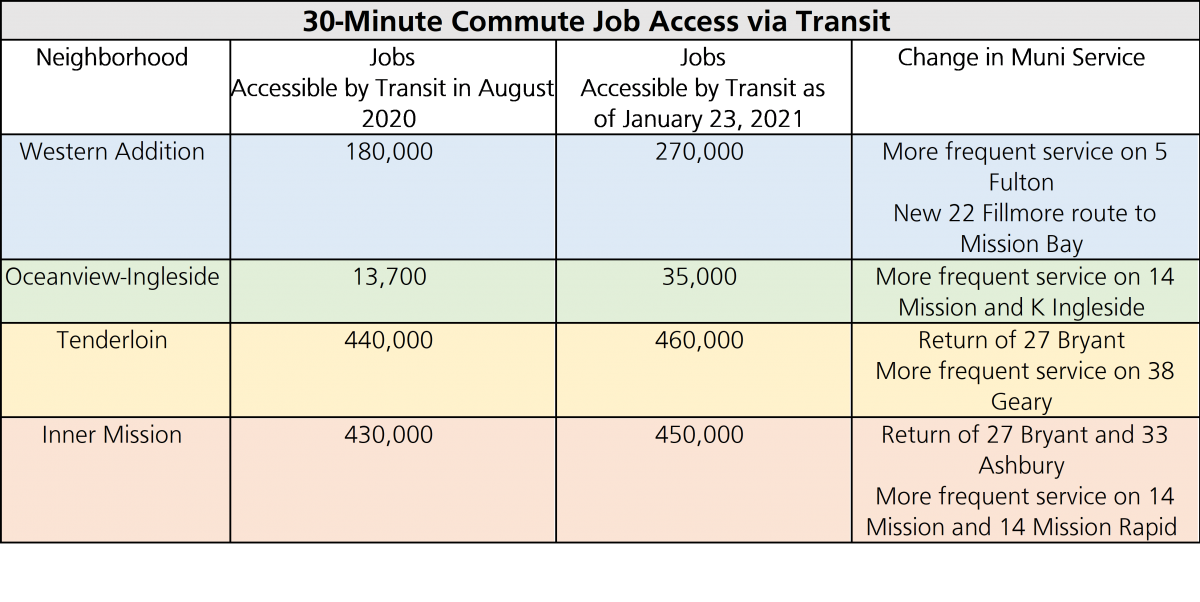
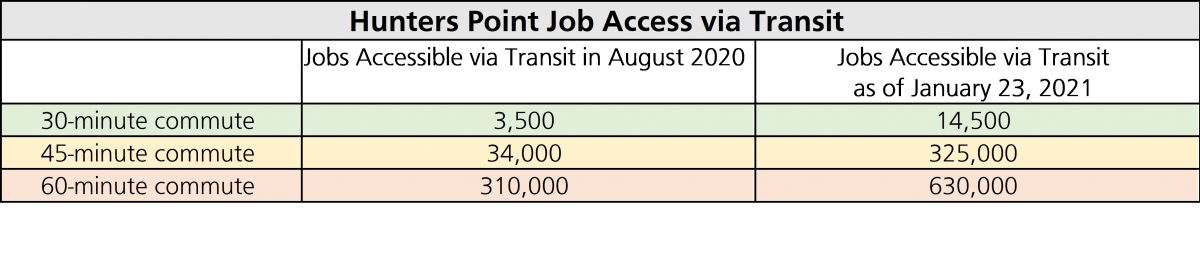
Lessons Learned
The Equity Toolkit also shows some decreases in job access via transit in other neighborhoods identified by the Muni Service Equity Strategy. This reflects the Toolkit’s methodology and/or the impacts of service changes and helps us to understand where we need to make improvements in our data collection, transit service or both.
Bayview job access increased for commutes of 45 and 60-minutes, but decreased 11% for 30-minute commutes. How can that be? The answer is that the T Third bus substitution was replaced with rail service in December 2020, which makes different and fewer stops than the bus within a 30-minute time period. Overall, Bayview residents are still able to access more jobs now than in August 2020 – roughly 644,500 now compared to 624,000 then, a 3% increase.
In addition, we rely on fixed points of reference, such as the Bayview Opera House, to gather data and Bayview is a large neighborhood. We learned that using one community landmark for this area is not enough, so we will be adding additional landmarks in future analyses to more accurately capture service change impacts.
In Visitacion Valley we see decreases in job access via transit across the board. Like in the Bayview, we determined that the issue is both methodology and service. When we redistributed buses from the 8 Bayshore to 8AX to respond to changes in ridership, the community landmark (John King Senior Community) we were using to track the data only showed us the decrease from the 8 Bayshore, not the increase from the 8AX.
By comparison, more affluent areas show very low to no increases in job access via transit. This reflects our decision to prioritize resources on Muni service for essential workers and essential travel, especially for communities with the fewest options during this unprecedented pandemic. More affluent neighborhoods have more transportation alternatives readily available and more people who are able to work from home.
These findings give us insights we didn’t have before and help us think about service in new ways. As we learn from the Equity Toolkit we will continue to refine it and make it more detailed by adding more reference points for our data analysis.
As San Francisco gradually reopens and we continue to add back Muni service, we will also continue to evaluate the impacts through our Equity Toolkit and work to use these insights to inform service adjustments that support our city’s economic recovery.
Read more about changes to our network on the SFMTA’s Transportation Recovery Plan webpage.
Published March 30, 2021 at 07:33PM
https://ift.tt/2PkupwH
Show HN: Sleekplan – Feedback Board, Roadmap, and Changelog for Websites https://ift.tt/3wd2Jus
Show HN: Collect and View Data from SEC 13F Filings https://ift.tt/3cF4b0Z
Show HN: Build Autonomous Economically-focused Agents using the AEA framework https://ift.tt/3ruO2ze
Show HN: Yazz Visual JavaScript Now on the Mac App Store https://ift.tt/2PiVHDG
Show HN: Play with Shaders Inspired by Slime Mold https://ift.tt/3wdv2c8
Show HN: Writing a simple, event-driven, extensible, rich text editor framework https://ift.tt/3wbEaOp
Show HN: Poulette – A Color Palette GUI https://ift.tt/3dhWKf8
lunes, 29 de marzo de 2021
Show HN: Statsig – feature gates, dynamic config, experiments and more for devs https://ift.tt/39pGGqG
SFMTA’s Cable Car Signal Tower Gets a Refresh
By Jeremy Menzies
At the corner of California and Powell Streets stands a diminutive but important building that has been in use for well over 100 years. This octagonal signal tower controls the crossing of the Powell and California Street cable car lines, and recently underwent a full restoration thanks to the skilled craftspeople at the Cable Car Division.
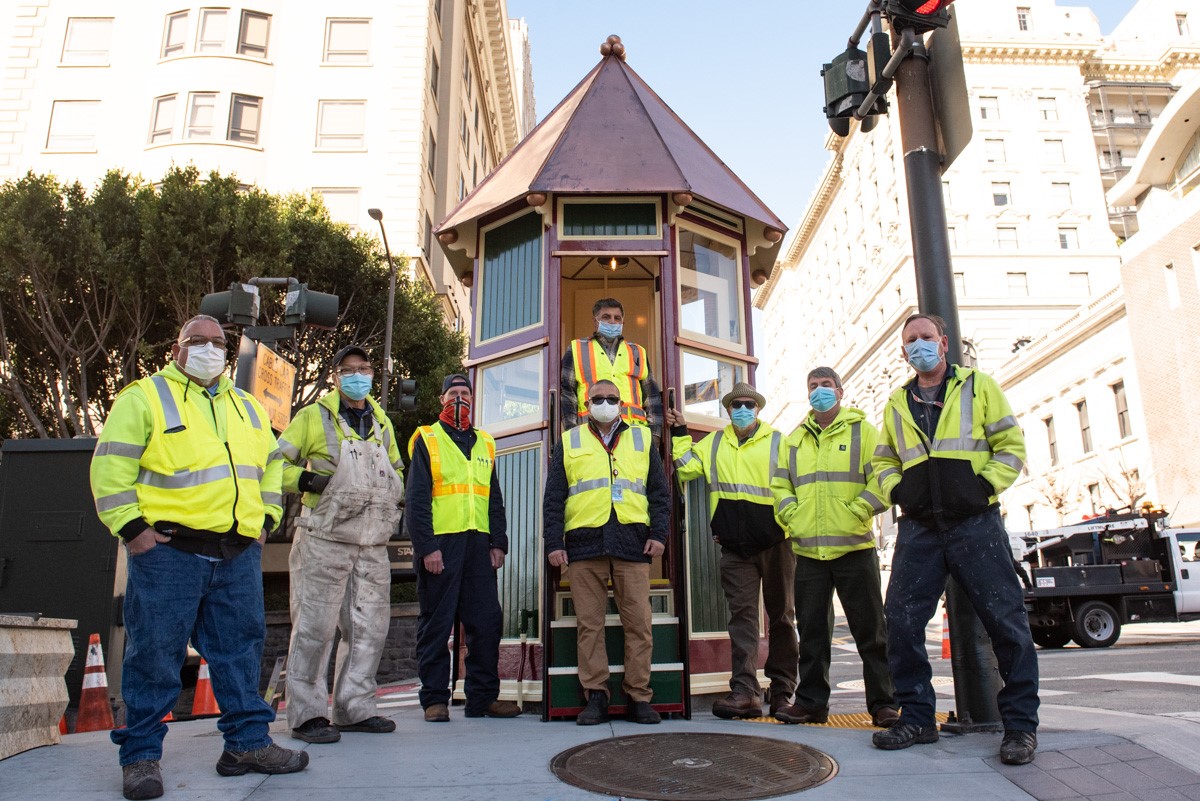
A group photo of Muni craftspeople and shop management who worked to restore the signal tower in 2020-2021.
The tower’s history dates to 1888 when the original was built by the Ferries and Cliff House Railroad, which operated cable cars on Powell Street at the time. That tower was destroyed in the 1906 earthquake and fires that ravaged Nob Hill. In March 1907, it was rebuilt by then-owner United Railroads of San Francisco (URR) and went back into operation.
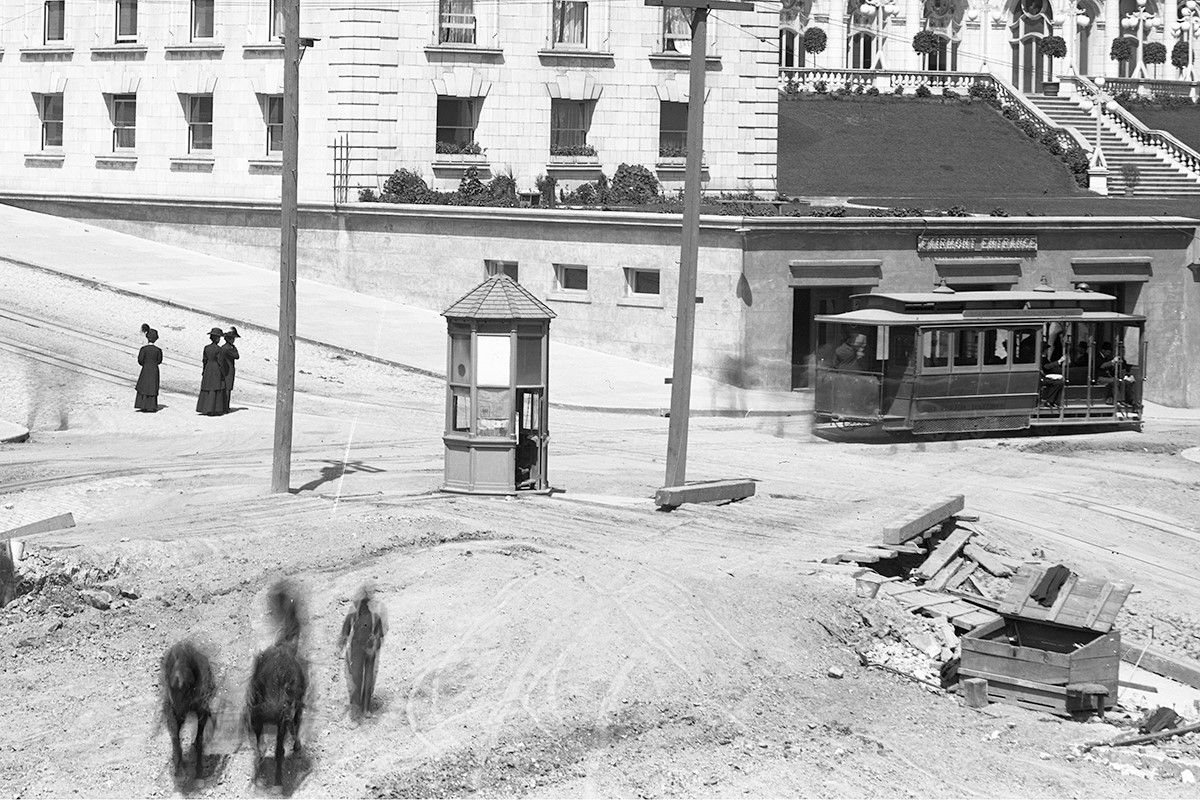
Photo showing signal tower in 1908 with the Fairmont Hotel and passengers waiting for a cable car in the background. Photo courtesy OpenSFHistory.org.
In 1935, a runaway automobile on California Street struck the tower, causing severe damage and tragically killing the signal operator inside. The tower was subsequently rebuilt, and a heavy metal barrier was installed on its west side.
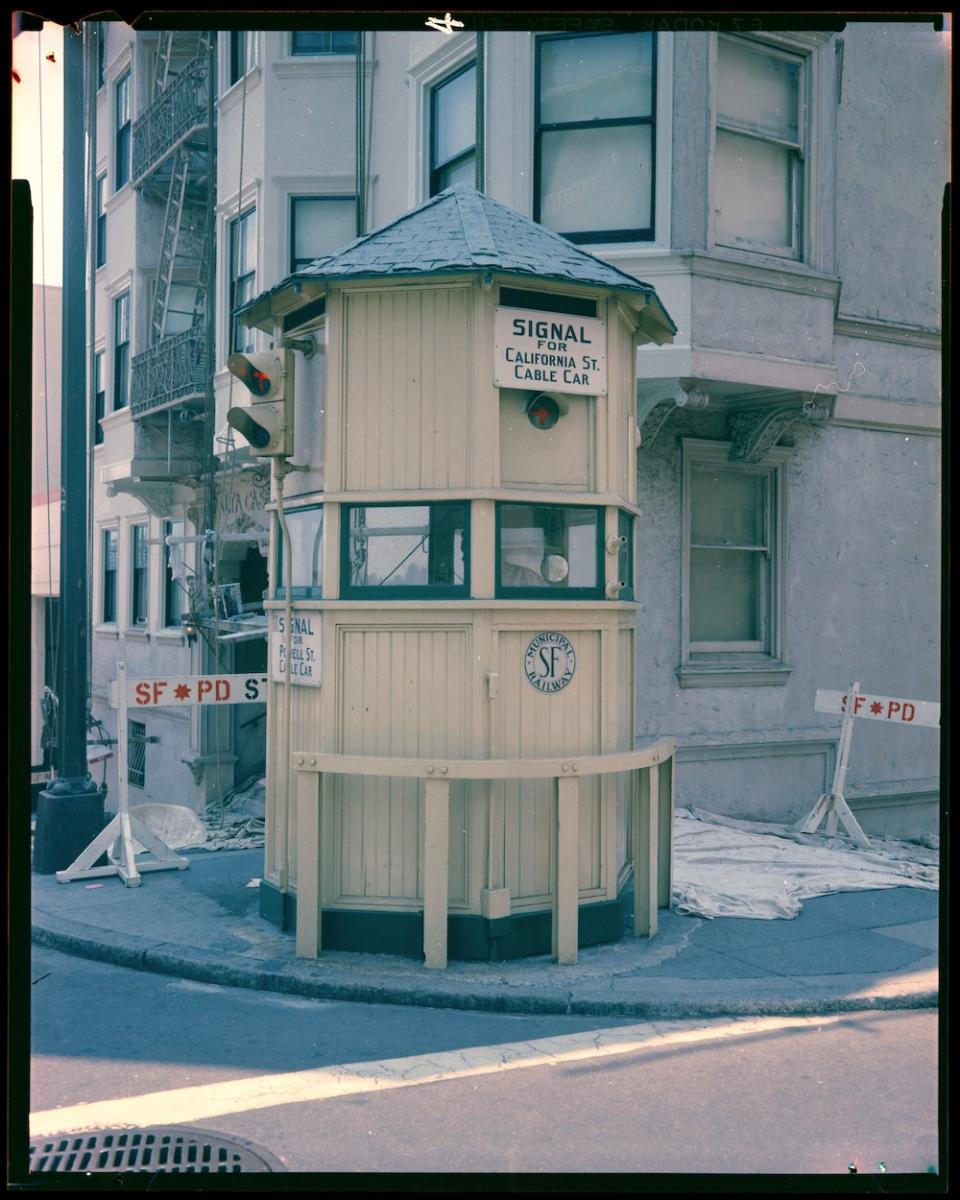
This 1966 photo shows the west-facing side of the tower, painted in green and cream, shortly before paint and repairs were done on the building.
The next major change came in 1967 when the tower was renovated and a new copper roof was installed. The structure was also repainted to reflect the maroon and tan color scheme of the California Street cable cars. Until 1982, the tower retained its manually-operated kerosene lantern signals originally installed in 1907.
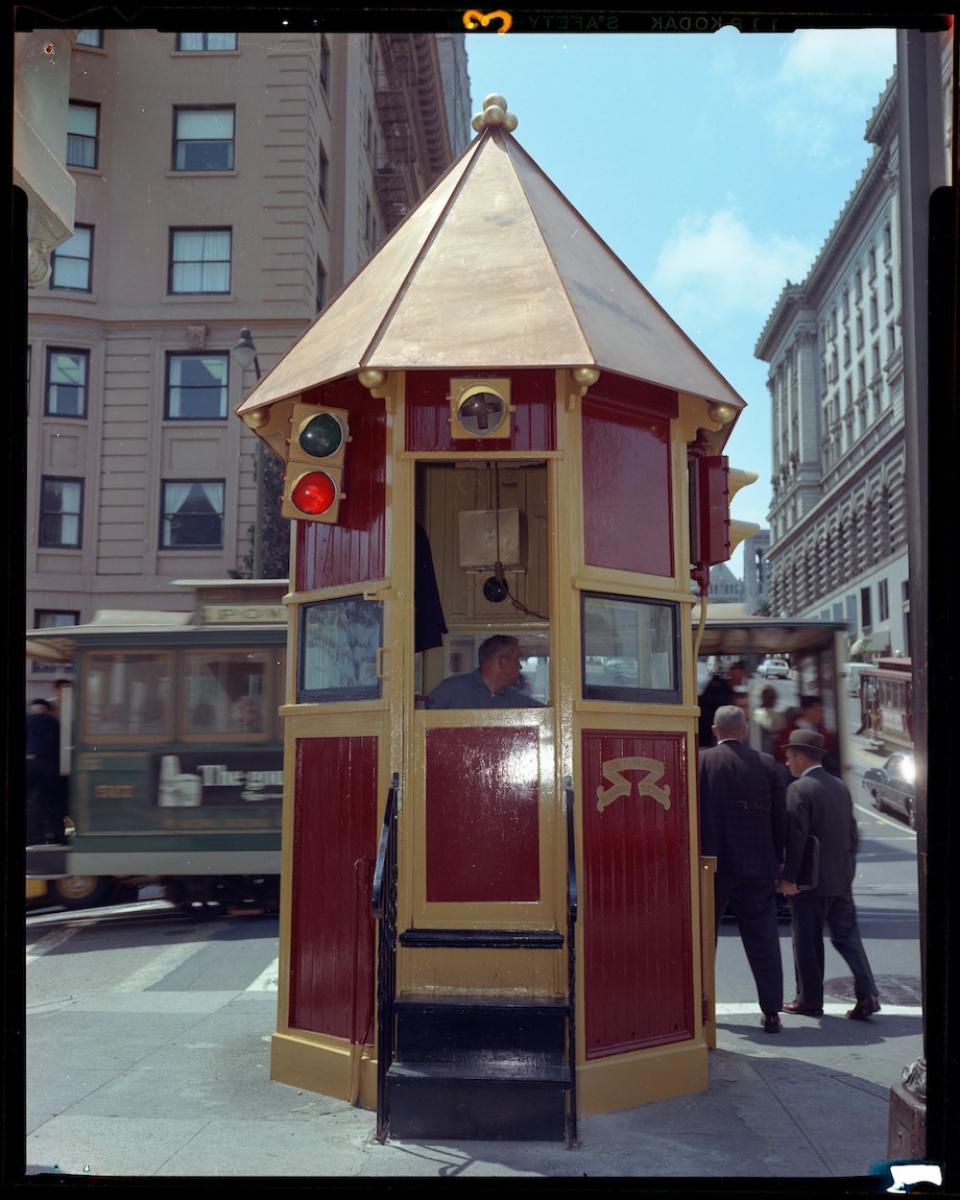
A 1967 photo showing the newly repainted and copper-roofed signal tower.
The suspension of cable car service during the Covid-19 pandemic proved an opportune time to give the little signal tower some much needed T-L-C. During 2020 and early 2021, SFMTA carpenters, painters, metal workers and mechanics undertook a complete overhaul of the building. A new floor, roof, ceiling, door, windows, steps, heating, lighting and electrical system were all built and installed.
As with our world-renowned cable cars, no detail was overlooked during the tower rebuild. Muni carpenters repaired woodwork throughout, custom-building both the octagonal ceiling and split Dutch door. Paint crews highlighted each element of the tower with colors that enhance the structure’s overall visual appeal. Our expert mechanics installed new electrical systems. Even the grab handles and handrails for the steps were custom built from materials that are also used on Powell Street cable cars by skilled metalworkers at the SFMTA’s Special Machine Shop. A final step in this rebuild will be the installation of new signals before the tower goes back into operation later this year.
Check out the gallery below showing photos of the tower through the years and the recent restoration.
Published March 29, 2021 at 11:10PM
https://ift.tt/3m39I4d
Show HN: 8bit live chat with Papercups and NES.css https://ift.tt/3wbRceQ
Show HN: Unlimited app designs, user stories, and landing pages https://ift.tt/3sxS1fO
Show HN: Beehive – Talk 1:1 About Anything https://ift.tt/39pAij2
Show HN: Canopy – API first loan servicing infrastructure https://ift.tt/2QGvEqg
Show HN: An open-source, self-hostable Heroku and Netlify alternative https://ift.tt/3szUA0S
Show HN: I wrote a program to convert lines of text into trees https://ift.tt/3ryfwnt
Show HN: WebRTC-Echoes: Interop for C#, C++, Python, TypeScript, Go and Servers https://ift.tt/31vbBNG
El Poder Transformador del Yoga: Descubre Cómo Mejora tu Salud y Bienestar
El Poder Transformador del Yoga ¿Qué es el Yoga? El yoga es una práctica antigua que combina movimientos físicos, respiración controlada y m...

-
Watch video on YouTube here: https://youtu.be/3tGZ-bSpFWE
-
Watch video on YouTube here: https://youtu.be/PzDZWY6mgGg


