“Fox_Marc Gaming Cryptocurrency: Express Crypto https://t.co/GJsbUWYcVD”
sábado, 21 de marzo de 2020
Show HN: After many 14-hour coding days, my dream to-do app “Priorities” is done https://ift.tt/2U6uOlX
Show HN: After many 14-hour coding days, my dream to-do app “Priorities” is done https://ift.tt/3aa5tNF March 21, 2020 at 06:15PM
Show HN: Fast database for react-native with multiple data types support https://ift.tt/2xikE8J
Show HN: Fast database for react-native with multiple data types support https://ift.tt/2TYC56i March 21, 2020 at 04:19PM
Show HN: How to Find a SaaS Idea https://ift.tt/3b84vl8
Show HN: How to Find a SaaS Idea https://ift.tt/2U7zsjw March 21, 2020 at 01:27PM
viernes, 20 de marzo de 2020
New Preventative PSA Campaign
New Preventative PSA Campaign
By Amy Fowler
Published March 20, 2020 at 11:34PM
https://ift.tt/2vGNEXy
By Amy Fowler

The SFMTA launches preventative PSA campaign on how to slow the spread of COVID-19
The SFMTA, in collaboration with the San Francisco Department of Public Health and Centers for Disease Control and Prevention (CDC), has launched a “Stop the Spread of Germs” Public Service Announcement (PSA) campaign on Muni vehicles to keep city residents informed about how they can help slow the spread of novel coronavirus (COVID-19).
These preventative messages are going up throughout our system—as signage both inside and outside of vehicles, audio alerts on buses, NextMuni displays at bus shelters and signs at Muni Metro stations.
While the SFMTA has implemented some service reductions in response to ridership drops, many still rely on Muni to make essential trips during this challenging period. These messages serve as helpful reminders, both on the bus and the street, that we all play an important role in preventing the spread of coronavirus.
The San Francisco Department of Public Health and the Centers for Disease Control and Prevention (CDC) recommend these simple daily precautions:
- Wash your hands often with soap and water for at least 20 seconds.
- Avoid touching your eyes, nose and mouth with unwashed hands
- Cover your cough or sneeze with a tissue, then throw the tissue in the trash
- Stay home if you are sick, except to get medical care
- Clean and disinfect frequently touched objects and surfaces
- Avoid close contact with people who are sick. Put distance between yourself and other people.
- Those who are 60 and older, or with a health condition or a weakened immune system should limit outings and avoid community events
- Please do not ride Muni if you are feeling ill, except as necessary to seek medical care after consulting with your medical provider.
We are closely monitoring what is happening with the novel coronavirus (COVID-19). Please check SFMTA.com/COVID-19 and cdc.gov/COVID19 for the latest updates.

Signage is being installed both inside and outside of Muni vehicles and in stations to promote awareness about how to prevent the spread of coronavirus.
Published March 20, 2020 at 11:34PM
https://ift.tt/2vGNEXy
Show HN: S-Cache – Secure storage for cryptographic secrets, modeled after sudo https://ift.tt/2J5vcuQ
Show HN: S-Cache – Secure storage for cryptographic secrets, modeled after sudo https://ift.tt/1Lu1Ss5 March 20, 2020 at 07:48PM
Show HN: Create Job Postings for Developers https://ift.tt/2J68UZY
Show HN: Create Job Postings for Developers https://ift.tt/3b78Oxc March 20, 2020 at 05:47PM
Show HN: An Experimental, Keyboard-First User Interface https://ift.tt/2UsfMWL
Show HN: An Experimental, Keyboard-First User Interface https://ift.tt/2Ww7rDW March 20, 2020 at 07:26PM
Show HN: What I've learned creating a React Native performance monitor https://ift.tt/2IZR2jk
Show HN: What I've learned creating a React Native performance monitor https://ift.tt/2WbYrnr March 20, 2020 at 06:34PM
Show HN: I made a small tool to download photos and videos from social media https://ift.tt/3bbAtgi
Show HN: I made a small tool to download photos and videos from social media https://loot.photo/ March 20, 2020 at 05:46PM
Show HN: Mobile Game – Car Hunters https://ift.tt/2UnAnvp
Show HN: Mobile Game – Car Hunters https://www.youtube.com/watch?v=n2vhYLDIvu0 March 20, 2020 at 01:34PM
Show HN: Vuiet – a music player and explorer for Emacs https://ift.tt/2UlOAZL
Show HN: Vuiet – a music player and explorer for Emacs https://ift.tt/2OR8KZM March 19, 2020 at 10:22AM
Show HN: One Profile – create your modern personal page for free https://ift.tt/2WwTG80
Show HN: One Profile – create your modern personal page for free https://ift.tt/2Fkuxn8 March 20, 2020 at 12:09PM
Show HN: Simplify your Stripe integration with Paysly https://ift.tt/2UoPt3B
Show HN: Simplify your Stripe integration with Paysly https://paysly.io March 20, 2020 at 02:40PM
Show HN: RudderStack, open-source CDI (a.k.a. open-source Segment) https://ift.tt/3diEMrW
Show HN: RudderStack, open-source CDI (a.k.a. open-source Segment) GitHub: https://ift.tt/2WCbGxI === Firstly, a big thanks to the HN community for showing us love and support in our previous HN post (https://ift.tt/2nmniFw). At that point, we had just open-sourced the repo and were not fully prepared for a Show HN. We wanted to share updates since then and also do our official Show HN. Updates since Sept 2019 1. Changed the name from Rudder to RudderStack :) 2. API compatibility with Segment 3. Open-source control plane so no dependency on the hosted control plane for open-source users. (https://ift.tt/2TLLIpY) 4. Multiple hosting options: Docker, Kubernetes, Terraform, Native. 5. ~30 integrations (https://ift.tt/3alYmkZ) including cloud mode and device mode 6. Support all the popular data-warehouses & lakes - RedShift, Snowflake, BigQuery, S3, Google Cloud Storage, Azure Blob Storage 7. Detailed documentation - https://ift.tt/2vp1z4s 8. Multiple production deployments including few really large ones (our largest deployment is sending a peak of ~40K events/sec, ~300M events/day) 9. Switched license from SSPL to AGPLv3 (after long discussions internally as well as on HN) 10. Built some interesting Analytics & ML use cases 11. Launched our “paid plans” (primarily around managed hosting) Wishing everyone best wishes for staying safe from COVID-19 March 20, 2020 at 02:22PM
Show HN: Global Speed, a web extension to set default speed for video and audio https://ift.tt/2Uo0JNJ
Show HN: Global Speed, a web extension to set default speed for video and audio https://ift.tt/33yATdV March 20, 2020 at 02:01PM
Show HN: CrowdCapture – create image datasets together https://ift.tt/2U63UdZ
Show HN: CrowdCapture – create image datasets together https://ift.tt/2UnIo3h March 20, 2020 at 08:50AM
Show HN: ShameYour.company –Report companies endangering workers during Covid-19 https://ift.tt/2J4hkB2
Show HN: ShameYour.company –Report companies endangering workers during Covid-19 https://ift.tt/2vCeArr March 20, 2020 at 01:01PM
Show HN: I build an app that ensures that I track my home office working hours https://ift.tt/2vyA6NA
Show HN: I build an app that ensures that I track my home office working hours https://ift.tt/2RChTY8 March 20, 2020 at 11:43AM
Show HN: superstring - A fast and memory-optimized string library for Python https://ift.tt/2IZyfEz
Show HN: superstring - A fast and memory-optimized string library for Python https://ift.tt/2QwTNww March 20, 2020 at 05:26AM
jueves, 19 de marzo de 2020
Show HN: Watch nearly empty cities all over the world with EarthCam https://ift.tt/393UEeD
Show HN: Watch nearly empty cities all over the world with EarthCam https://ift.tt/2uwBnz9 March 20, 2020 at 03:24AM
Show HN: Rotation Using Euler Angles https://ift.tt/3bbgJcz
Show HN: Rotation Using Euler Angles https://ift.tt/3a4T8dH March 20, 2020 at 03:09AM
The SFMTA Budget Process
The SFMTA Budget Process
By
Published March 20, 2020 at 02:42AM
https://ift.tt/2QxyN8X
By
We recognize the Coronavirus pandemic and current shelter-in-place order have significantly changed our daily routines. The timeline for the SFMTA budget approval has not yet changed, and as such, we are taking steps to ensure we continue to engage in a thoughtful and comprehensive community process in light of the current circumstances. If you would like to comment on the budget, please email sfmtabudget@sfmta.com, call 415.646.2222, post on our Facebook page or Twitter #sfmtabudget @sfmta_muni. You can also visit our Budget webpage.
Overview of the SFMTA Budget Development Process
Every two years, the San Francisco Municipal Transportation Agency (SFMTA) must finalize and adopt a consolidated budget with projected revenues and expenditures for the following two years[1]. Currently the FY2021 & FY2022 budget process is underway, and community members can participate in the budget process in the coming weeks. On May 1st, the Mayor approves the budget and sends it to the Board of Supervisors for a final vote. This blog, the first in a series diving into the budget process, will provide a high-level overview of the SFMTA consolidated budget components, purpose, and development process. The blog posts that follow will build upon this overview and cover specific SFMTA budget topics:
- Revenue, Expenditures, and our Forecast
- Policy objectives and funding priorities
- Overview of outreach
- Adopted Budget and What it includes
What is the SFMTA Budget Process?
The consolidated budget covers a two-year period and has two parts: the Operating and the Capital budgets. The Capital budget is for new and on-going projects; the Operating budget is for daily services[2] and maintenance. For example, buying new LRV4 trains to replace our light rail fleet is within the Capital budget, while the salaries of our train operators is within the Operating budget. As the example shows, the Operating and Capital budgets are developed in tandem for the SFMTA’s budget process.
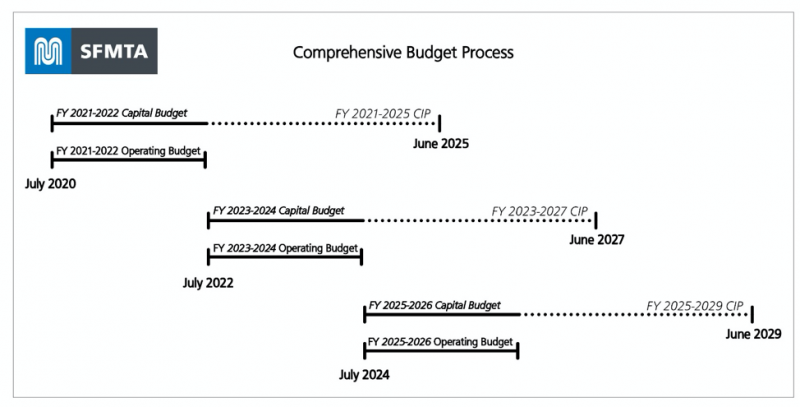
Additionally, the Capital budget reflects the first two years of the five-year Capital Improvement Plan (CIP). The CIP is a policy document detailing the projects that the agency aims to implement over the five-year period and is based on city-wide planning initiatives & project-specific feedback. A new CIP is developed each budget cycle, meaning that the outer three years of the current CIP are reevaluated, adjusting projects to evolving policies and conditions. For example, as the need for our new LRV4 trains became more urgent, we changed our plan so that the trains could be bought sooner.
The five-year CIP and two-year Capital and Operating budget documents show how the SFMTA plans to allocate available resources to meet our Strategic Plan goals. Both the consolidated budget and the CIP are submitted to the SFTMA Board for approval. Following this, the budget is submitted to the Mayor and the Board of Supervisors for review and approval.
Why does the budget matter?
The budget is the strongest reflection of our values. It is a commitment and a plan for how we will dedicate resources to better serve the public. The SFMTA’s projects and services are limited by funding[3], requiring the SFMTA to make difficult choices about what needs should be prioritized and funded. The budget details how and when we will implement relevant projects and meet our goals.
How does SFMTA develop the budget?
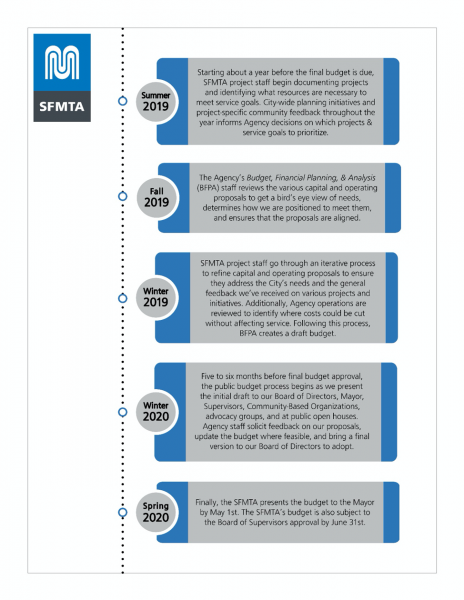
Generally, the budget is developed through the following 5 steps:
Where to find additional information
In the upcoming weeks, we will be publishing additional blogs that will provide more detail on specific aspects of the budget process. For additional questions, please review the following documents or email sfmtabudget@sfmta.com.
- SFMTA Strategic Plan (2018)
- Details our vision, what we need to do to get there and how we will measure progress along the way.
- SFMTA Board of Director's Presentation (3/17/2020)
- The most recent public presentation of the proposed budget (FY21 and 22) along with the challenges and decisions that the board will have to facilitate.
- SFMTA 20-year capital plan (2017)
- This is a fiscally unconstrained assessment of the SFMTA’s anticipated capital needs in the next 20 years. It identifies the investment needed to meet the agency’s and city’s transportation goals, and informs the Capital side of each two-year comprehensive budget
- SFMTA 5-year Capital Improvement Program (2019)
- This details the fiscally constrained set of projects that the agency aims to implement by June 30th, 2024, based on city-wide planning initiatives & project-specific feedback.
- SFMTA Performance Metrics
- These interactive dashboards track the agency’s progress in meeting its goals and objectives as outlined in the Strategic Plan
- SFMTA Automatic Indexing Policy
- For more information on how the agency sets charges based on inflation
- SFMTA Contingency Reserve Policy
- For more information on how the agency works to ensure financial stability
Coming up next in our series: Revenue & Expenditures
[1] The 2-year budget cycle is required as a result of voters passing 2009’s Proposition A
[2] Per City Charter, the types of services that the SFMTA provides are mandated
[3] Per City Charter, the SFMTA budget must be balanced, meaning that projected expenditures must be no greater than our projected revenues.
Published March 20, 2020 at 02:42AM
https://ift.tt/2QxyN8X
Show HN: .mixtape - indie and vaporwave https://ift.tt/2U2qmVs
Show HN: .mixtape - indie and vaporwave https://ift.tt/3a1fufY March 20, 2020 at 01:19AM
Mejores faucets Auto y manual 2020

FIREFAUCET
es uno de los mejores sitios, faucet, oferwall, auto etc, la suma diaria puede ser infinita haciendo todas las tareas, unos 2000 satoshis diarios trabajandola a tope. mínimo de pago bastante bajo, casi para cobrar a diario y instantaneamente.

Otro gran sitio con mínimo de pago muy bajo, ptc, faucet sorthlinks etc, pagando sin problemas.

Es otra microbilletera que trabaja exclusivamente con los 7 sitios que tenemos debajo, estos sitios son posiblemente las faucets más antiguas y confiables, se puede ganar mucho con ellas entrando todos los días, debido a que tienen los bonos de fidelidad, bonos misterio y un gran programa de referidos, estas no te pueden faltar en tu trabajo diario.
MOONBCH

MOON LITECOIN

MOON DOGECOIN

MOON BITCOIN

MOON DASH

BIT FUN

BONUS BITCOIN

FREEBITCOIN.IN

Os presento 2 sitios que pagan muy bien, haciendo misiones , juegos y minería en la nube, he cobrado de los dos bastante rápido.
CRYPTOMINING GAME


FAUCETS

Y por supuesto las faucets, hay miles en la red, solo tienes que buscar unas pocas porque todas no se pueden hacer jeje,
RAMDOOM SATOSHI

Estas son quizás las mejores con las que trabajo, faucets reconocidas y de las que más pagan, no es necesario hacer demasiadas por que no hay horas en el día, pero con estas es suficiente para sacar un buen número de cryptos a diario.
AUTOFAUCETS
Las autofaucets son automáticas, haces unos sorthlinks y te va añadiendo tiempo. solo hay que dejarlas trabajar solas y cada minuto te envía un pequeño pago a tu microwallet, pagan poco pero son buenas para subir el nivel en las microwallets y ganar algo sin hacer nada.
Suscribirse a:
Entradas (Atom)
Panel JARVIS: Diseñando tu Centro de Control de IA Local Avanzado
Panel JARVIS: Diseñando tu Centro de Control de IA Local La Inteligencia Artificial (IA) se ha posicionado como la fuerza motriz de la tra...

-
Watch video on YouTube here: https://youtu.be/3tGZ-bSpFWE
-
Watch video on YouTube here: https://youtu.be/PzDZWY6mgGg


